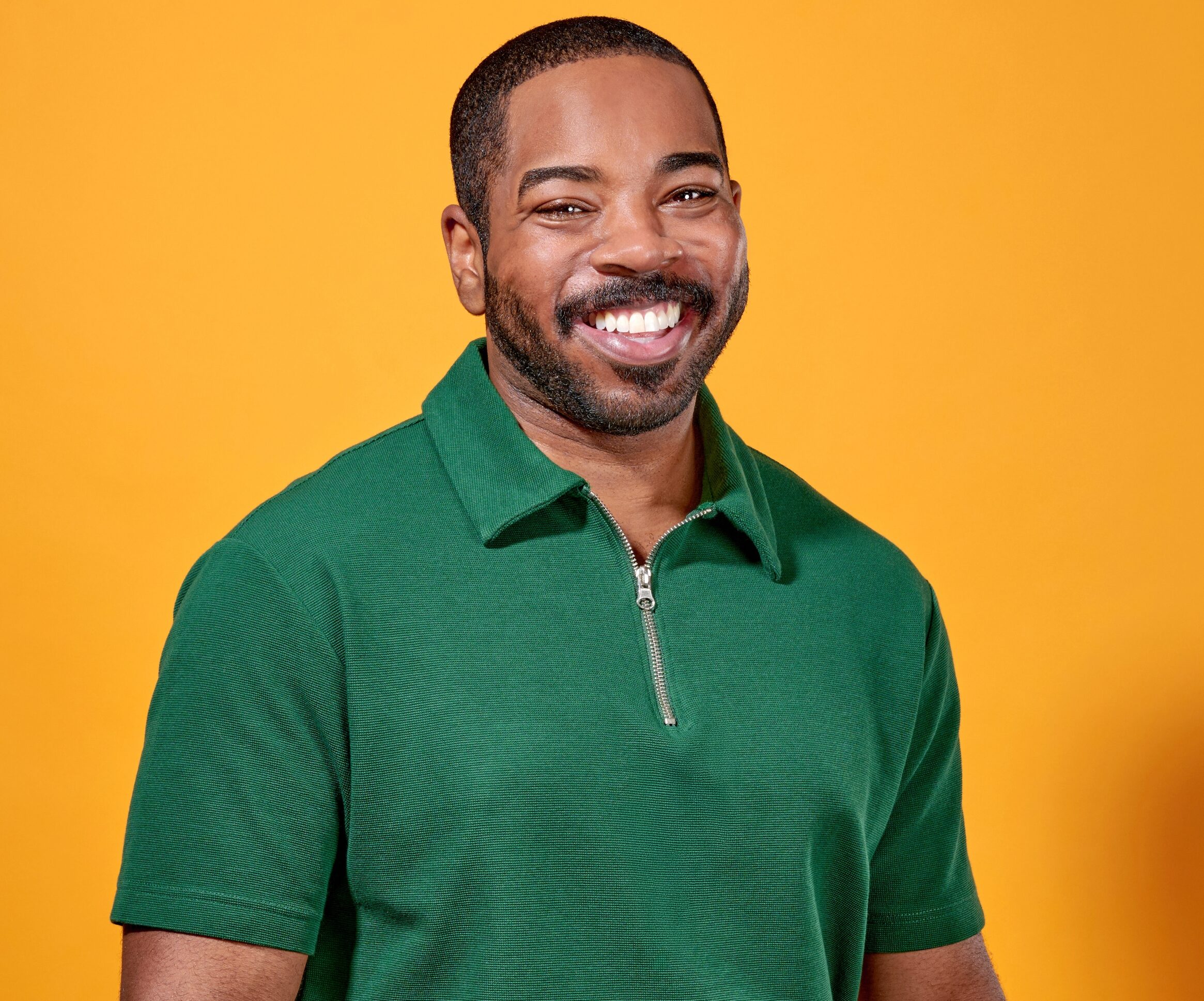
source: Kasim Hardaway
A wonderful life is not for what you achieve, but for who you are? For artist, filmmaker, and storyteller Kasim Hardaway, that question became the foundation of a deeply personal journey from burnout and perfectionism to healing and authenticity. Through projects like The UNBecoming and Take What You Need, Hardaway is creating spaces where vulnerability is welcomed, connection is celebrated, and people are reminded that they were never meant to carry life’s hardest moments alone. In this candid conversation, he reflects on redefining success, embracing therapy, and why letting go of who we think we’re supposed to be may be the most transformative act of all. Let’s dive into a Q&A with Kasim Hardaway.
You said you were “very good at saying I was fine.” Looking back, what were the signs that you weren’t, and why do so many people become experts at hiding their struggles?
I had become incredibly good at functioning. I was over-productive, reliable, successful on paper, and outwardly cheerful. But beneath all of that, I was anxious almost constantly. I couldn’t sit still, rest felt uncomfortable. I felt like I always needed to be producing something to justify my existence.
I think a lot of us become experts at hiding our struggles because we’ve learned that functioning is rewarded while vulnerability often isn’t. If you keep showing up, keep smiling, keep getting things done, people assume you’re okay. Eventually, you start believing you have to keep performing “fine,” even when you’re anything but.
Your career was built around constant visibility and measuring success through metrics. Do you think social media has changed the way we define our worth, and if so, how do we reclaim it?
I don’t think social media created the problem, but it certainly amplified it. Suddenly we have dashboards for our humanity. Views, likes, followers, shares… it’s easy to confuse visibility with value. The difficult part is that those metrics aren’t inherently bad. They can be useful. The problem is when they become the only mirror we look into.
For me, reclaiming my worth meant creating things that couldn’t be measured by an algorithm. You can’t quantify someone crying because they finally felt understood. You can’t graph a conversation between strangers. Those moments reminded me there are forms of success that don’t fit neatly inside analytics.
You describe therapy as the thing that brought you back to yourself. What surprised you most about that journey, and what do you wish people understood about asking for help?
I expected therapy to give me answers. And of course, sometimes you leave a session feeling settled by something that resembles an answer. But personally, I found it gave me better questions. The biggest surprise was realizing I wasn’t broken. I had simply accumulated beliefs, habits, and coping mechanisms that once protected me but no longer served me. Therapy wasn’t about becoming someone new. It was about understanding how I got here and slowly finding my way back to myself.
Asking for help isn’t admitting defeat. It isn’t a sign of weakness. If anything, I think it’s a strength. It takes courage to say, “I can’t carry this by myself anymore.”
Healing was never meant to be a solo project. We celebrate independence so much that we sometimes forget humans have always needed other humans.
Your work often explores “the things we quietly carry and don’t always have language for.” Why do you think art can sometimes express what conversation cannot?
Because art doesn’t demand an immediate response.
A conversation can feel exposing sometimes. Art gives us permission to arrive quietly. You can stand in front of a photograph, watch a film, or pull a letter from Take What You Need without anyone asking you to explain yourself.
Your film The UNBecoming suggests that sometimes growth isn’t about becoming someone new…it’s about letting go of who we’ve been told to be. What parts of yourself did you have to “unbecome”?
Sheeesh… where do I even start? The UNBecoming exists because I could probably spend hours answering that question. I mean, I wrote an entire book about my own unbecoming. There are so many beliefs, behaviors, identities, and expectations that accumulate over 35 years of living on this planet. But if I had to narrow it down, there are three masks I had to set down. The first was the perfectionist who believed mistakes were proof of failure. The second was the performer who thought being admired was more important than being authentic. And the third was the person who measured his value by productivity.
The irony is that none of those identities were ever really me. They were survival strategies. Letting them go didn’t make me someone different. It helped me remember who I’d been underneath them all along.
And that’s really the genesis of The UNBecoming. It’s the belief that becoming isn’t always about adding more to ourselves. Sometimes it’s about letting go of everything that was never really us in the first place.
Burnout has become almost a badge of honor in many industries. At what point does ambition stop being healthy, and how can people recognize they’ve crossed that line before it’s too late?
I’ll start by saying that I don’t think ambition is the problem. I think abandonment is.
Ambition becomes unhealthy the moment you consistently abandon yourself in pursuit of achievement. When your relationships suffer. When your body starts sending signals you ignore. When every accomplishment simply moves the finish line instead of bringing satisfaction. If success requires you to become a stranger to yourself, the cost is definitely too high.
Take What You Need invites strangers to pause and reflect together. In a world that’s constantly telling us to move faster, what happens when we intentionally slow down?
Something quite remarkable happens.
People remember they’re human… and I know that sounds a cheesy AF, but it’s true! I’ve watched complete strangers stand beside one another in silence, reading letters. I’ve watched conversations begin between people who otherwise would’ve walked right past each other. Slowing down interrupts autopilot. It creates just enough space for reflection, connection, and sometimes healing. I think we’re all craving that more than we realize. The beautiful thing is that the installation doesn’t force any of that to happen. It simply creates the conditions for it. The rest is just people being people.
You’ve shifted from creating content designed to capture attention to creating art designed to create connection. How has that change transformed your definition of success?
For years I asked, “How many people saw it?” Now I ask, “How deeply did it affect the people who did?”
That’s a completely different metric.
Some of the most meaningful moments in my career have happened in complete silence. Someone quietly taking a letter. Someone hugging a stranger. Someone saying, “I thought I was the only one.” That’s realdeal success to me.
Many people have a creative dream they’re afraid to pursue because of fear, financial pressure, or expectations from others. What gave you the courage to leave a successful career and trust your artistic voice?
I wish I could tell you it was courage. It was certainly not courage. It was necessity. The life I had built no longer fit the person I was becoming. Staying would’ve been easier financially, so much easier, but impossible emotionally. I will say the fear never disappeared; it still pops up time and again. I simply reached a point where the fear of staying the same became greater than the fear of changing.
If someone leaves one of your installations or finishes watching one of your films feeling a little less alone than when they arrived, what do you hope they’ve discovered about themselves?
That there was never anything wrong with being human. That the messy, emotional, uncertain and contradictory parts of themselves aren’t flaws to overcome, but experiences that connect us to one another (!!!) We spend so much of our lives believing we’re the only ones who feel highly anxious, lonely, ashamed, insecure, uncertain, or overwhelmed. We quietly convince ourselves that everyone else has it figured out while we’re somehow falling behind. My work exists to gently challenge that illusion. Those experiences don’t make us defective, and they certainly don’t make us unique. They make us human. If someone walks away with a little more compassion for themselves, a little less shame, or the quiet realization that they were never carrying these things alone, then I think the work has done exactly what it was meant to do.
Red PaSH Magazine is a lifestyle publication. Our slogan is “all your tiny obsessions.” We are strong advocates of self-love, self-care, body positivity and supporting minorities, especially women, people of color and communities not highlighted in mainstream media. Please send pitches to southernpashmag@gmail.com. Please note that we sometimes use affiliate links. If you purchase anything from a link we have provided, we may receive a small commission. This money is used to help support our efforts at PaSH Inc. Check out our sister magazine, PaSH Magazine and exploregeorgianow.com.